Garifuna Tours
 Home :: History :: Geography :: Society Today :: Organization  :: News and Articles :: Spanish / Español

The Garifuna Community
          

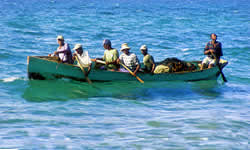
Men on boatWelcome to the Garifuna World! You are about to experience the origin of the Garifuna community, their incorporating process to society, their resistance to English and French Colonization and their deporting to Honduran land.
The Garifuna society, also known as the Black Caribs, was first originated in XVII in San Vicente, about a century after the conquering of Central America, South America, and the lower Antilles. The conquerors were not interested in San Vicente and Dominica at first because of its topographic features, lack of precious metals and grasslands for cattle raising, but the Caribs did become interested because of its magnificent areas for fishing.

Who were the Caribs? The Caribs were strong, robust men, of small stature, and mongoloid physical features. They had long, black, straight and thick hair, perfectly cut to their forehead and were generally dressed in a colorful christening skirt. Their original name was Callinagu and their place of origin was from the Orinoco Delta, which they abandoned for conquering the Lower Antilles. When they arrived to the Lower Antilles, they exterminated the Arahuaco men, but decided to keep the women for their convenience. The union of these two Indian groups gave origin to a new society called the Caliponan (also known as the Yellow Caribs, Red Caribs, and Amerindians).

Formation of the Garifuna Society
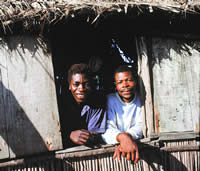
Garifunas in TelaThe beginning of the formation process was in 1635, and believed to have been caused by the sinking of two Spanish ships loaded with black slaves who were being delivered to their buyers. In those days it was common for the Caliponan to give misleading directions, which lead them to the riverbanks where they disposed the ships from their shipments (gold, wine, and slaves) and killed all of the crewmembers.

The Africans were anxious to establish friend links to avoid being sent back to their owners as slaves; therefore they soon adopted their customs and native language. Short after, they married the Caliponan women who gave birth to a whole new kind of siblings. Their descendents preserved the height and skin color of their father, who on the contrary of the Caliponan were tall and corpulent. This new society (Garifuna) centered their family life in the sexual division of work as a base for their economic activities.

Short after came the conquering of Barbados and Santa Lucia, and men, who could not accept the new rulers, accumulated goods and emigrated in canoes towards San Vicente (28 miles from Barbados). These men, along with the Caliponan, then became such powerful allies in their war against conquerors, that they were considered an allied and independent group.

In the XVII century, a drastic change occurred in the Vicentinian society. The black society had become the dominant group due to their geometric growth because of the immigration of refugees. The constant fighting for power and territorial disputes soon divided both sides. Garifunas forced the Caliponan to move to the Western part and they move to the Northwestern part of the island. Both groups tried to resolve their personal difficulties, because they were aware that an internal division would drive the conqueror's attention to them.

When news about their differences arrived to France, the French took part in this division by supporting the Caliponan. They soon inhabited Caliponan land, while Garifunas defended their land from any European colonization. The French made many intents, but they soon were convinced they had to stop interfering and had to maintain peace links with Garifunas.
Garifunas acquired the French taste for wine instead of rum, dominated French language, incorporated French words to their dialect, adopted the French currency as a mean for commercial trading, obtained French names and customs, and eventually became their allies against the English colonization.   >> Top

French and English Interference

The three coming decades, 1730-1762, were characterized by the constant disputes between France and Great Britain for the desire of gaining power over San Vicente, Dominica, and Santa Lucia. The occurrence of these acts can be described as follows:

1730: San Vicente, Dominica, and Santa Lucia are declared to be free from European inheritance.
1742: British colony is established in Rattan (Roatan).
1748: Aix-La Chapelle Treaty is signed in which San Vicente, Dominica, and Tobago are declared of exclusive possession of the Caliponan natives.
1750: Peace Treaty signed between Spain and Great Britain.
1756: War between France and England begins.
1759: English attack Martinica, and take over Guadalupe Island.
1761: English take over Dominica.
1762: Martinica is taken over by the English (February 4th). In that same date Granada, Tobago, San Vicente, and Santa Lucia were ceded to Great Britain.
1763: Paris Peace Treaty is signed. San Vicente, Grenada, and Dominica were ceded to Great Britain; Cuba was given to Spain; Guadalupe, Martinica, and Santa Lucia were ceded to France.

Great Britain then declared war against the French; the disputing possessions were Martinica, and Santa Lucia. These acts of treason infuriated the French, who in reprisal, responded by exporting their revolutionary ideals to the Caribbean Islands in possession of the English. However, Garifunas understood that these philanthropic manifestations were not to be taken seriously, because most French wanted desired that Garifuna and English would destroy each other and consequently be force to leave the island. Therefore, Garifunas demanded sufficient warlike material from the French as a guarantee of their noble intentions.   >> Top


The War of Exile

First Phase: the Garifunas led by Du Valleé were such a powerful group that they constantly defeated the English. This group gained power over Kingstown, Dorset shire Hill, and another group lead by Chatolier gained power over Chateaubelair. Both groups soon joined forces, along with men that they ha collected in their way, and became such a powerful group that many feared them.
Soon came the death of Chatolier, who was convinced of his paranormal powers and invincibility, who made the fatal mistake of asking Alexander Leith (English) to a duel that caused his death. Chatolier`s death evidently confused the Garifuna-French alliance who held the fighting back and carefully awaited for the next step.

Second Phase: In this stage, the hostility lasted a little more than a year, and was characterized for being a war of exhaustion. Set before the numerous losses of seven months of fighting, and finding no solution to solve their differences, the English governor accompanied by the military force of 4,000 men decided to attack the Garifuna-French alliance. Faced upon the military power force upon them, the Garifuna determined that it was convenient to stop the war and finally surrendered.


Garifuna Expatriation

The English began to worry about their future in the island in comparison to the unexpected number of Garifunas living in their new territory. Therefore, the search for new land where the Garifuna could settle began.

Finally in February 20th, 1797, a total of 2,248 Garifunas along with stored food supplies were set aboard ships and then headed toward the Honduran Coast and Bay Islands. In April 12th, 1797, the Garifunas first set foot in Honduran territory.
Although the English left them with enough food supplies, utensils, fishing chords, and seeds for planting, it became a little difficult to clean the terrain and to plant before the rainy season began.

Garifunas then asked the Spanish to take them to the Honduran Coast. The Spanish accepted gracefully because they knew, that by doing this, they would now own the Bay Islands, and they would also acquire an additional labor force. The Spanish kept their promise; Garifunas arrived in Trujillo, Colon (Honduras) on May 17th, 1797.

In the early 1900s more then 100 enterprises had been exporting bananas from the Central American coast and Garifunas were involved in this commercial trading by helping these companies with the sowing and loading of banana. These companies soon extended their trading circle along the coast f Honduras and concentrated their fruit shipping along Punta Castilla (Trujillo), Tela, La Ceiba, and Cortés in Honduras; and in Livingston and Puerto Barrios in Guatemala, and finally in Belize City. Garifunas mostly concentrated in nearby towns because working for these companies had become a good source of income. However, in the 1940s some of these companies were shut down because their banana plantations had been greatly affected by plagues; this caused the unemployment of many Garifunas. Garifunas then got involved in the seafaring business where they immigrated to other parts of Central and North America.   >> Top

Garifuna Society Today
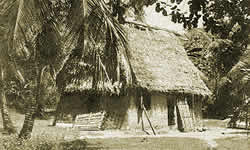
Garifuna ShackCulture: Their social and cultural characteristics are manifested in their archaic family and social structures, which have suffered very little changes. They still share their dialect, circular dances, religious practices, Punta dance, tales, banana cultivation, and rooster and pig sacrifices with the indigenous people of the Amazon.
Their ways of production are still based in subsistence farming. Among the different communities there is a great potential of production, and in most cases the land is very fertile for farming, however the only people involved are the elders because young people believe farming is not a great source of income. Youngsters are mostly dedicated to fishing, because most of the fish are set for sale and produce an immediate source of income. Youngsters show little or no interest in participating in social reunions with the rest of their community; elders and the women are usually the ones who interact with these reunions. It can be concluded that young Garifunas seem to be more interested in immigrating to North America.

Location: The Garifuna population that lives in the Atlantic Coast, between Belize and Nicaragua, is distributed in 43 towns and villages. Approximately 98,000 Garifunas live in Honduras, and they are mostly concentrated along the North coast from Masca, Cortés to Plaplaya, Gracias a Dios. Among other villages are: Santa Rosa de Aguan, Tornabé, Limón, Nueva Armenia, San Juán, Cosuna, Triunfo de la Cruz, and Baja Mar.

Health: Garifuna are subject to poor sanitary conditions throughout most of the area. The lack of clinical establishments, basic infrastructure projects, illness prevention programs, and nutrition programs greatly affect Garifunas. We can conclude that about 78% of the children under 12 years of age suffer from malnutrition, and that 3 out of 10 will die before they are 2 years old.

Housing: their housing consist of small huts with walls made of royal palm, sugar cane and of cement blocks. The ceiling is commonly made of hay, however they also use zinc as a ceiling too. There is a great tendency to replace their traditional style of housing for more modern types; however, these changes have helped improve their health conditions.

Politics: Garifunas do not believe in politics, they believe that they are too peaceful and that they can handle their personal problems without the intervention of any legal force; however, in some areas a governor is in charge of providing justice between the people. Only Garifunas that had the opportunity of being well educated are the ones that occupy government positions today.

Language: Most Garifunas not only speak Spanish, but also use the Igñeri dialect that is a combination of Arahuaco, French, Swahili, and Bantu.

Religion: Garifunas still maintain their own religious system that is a mixture of African and Amerindian traditions to which they have incorporated Catholic elements. Of great importance is the Garifuna religious system called Gubida that is the conception of the dreams and possession rituals as altered states of conscience considered, by the participants and believers, to be caused by the possession of a spiritual entity.

Education: 72% of the population is illiterate or semi-illiterate. Not enough schools are provided for them in he nearby areas; and villages that have schools, only have teachers to provide them with enough education to reach a 3rd grade level and sometimes a 6th grade level if they are lucky. Only 10% of the Garifunas who finish elementary school continue with their studies, another percentage immigrates to the United States, and the rest just integrate their community life and eventually become illiterates again because of the lack of practice.   >> Top

Organizations in Representation of Garifunas

· ONECA (Organización Negra Centroamericana/Central American Black Organization). The largest umbrella organization for Black communities in Central America and the Caribbean. President: Celeo Alvarez Casildo

· ODECO (Organización de Desarrollo Étnico Comunitario)

Objectives:
1. Development of Local Capacities.
2. Incidence and Empowerment of Afro-Honduran population.
3. Institutional Development, Fortification, and Efficiency.

Its Directive Board is composed of 15 members, nominated as follows:

President: Celio Álvarez Cabildo Secretary: Zulma Valencia
Vice-President: Luis Francisco Green Technical Affairs: Onelia Colon
Public Prosecutor: Bernard Martinez Discipline Affairs: Robustiana Castro
Secretary of Education: Delsy Alvarez Children Affairs: Gregorio Jimenez
Secretary of Promotion: Galata Arzú Secretary of Youth: Karen Bargas
Secretary of Cultural Affairs: Laura Alvarez Secretary of Sports: Candida Blanco
Secretary of Feminine Affairs: Miriam Tifet Treasurer: Felicia Lacayo
Legal and Human Rights Department: Norman A. Jimenez

Website: www.caribe.hn/cumbrecontinentalafro/index.htm
Email: odeco@caribe.hn
Address: Bo. Potreritos, Avenida Júnior, ½ cuadra debajo de Escuela Copan Galel
La Ceiba Atlántida, Honduras, C.A.
Phone No.: (504) 443-3651 Fax No.: (504) 4434642
(504) 4402498

   >> Top

· OFRANEH: (Organización Fraternal Negra Hondureña).
Objectives:
1. Provide help to Garifuna Society.
2. Provide defense of Garifuna territory.
3. Defense of Garifuna's culture

Directive Board
General Coordinator: Gregoria Flores
Coordination Assistant: Miriam Miranda
Act Coordinator: Ana Lucy Bengoechea
Legal Affairs: Teófilo Lacayo

E-mail: ofraneh@laceiba.com
Address: Bo. Independencia, esquina opuesta Escuela Luis Landa.
La Ceiba, Atlántida, Honduras, C. A.
Phone No. : (504)-443-2492

>> Top

LOOKING FOR OTHER GARIFUNA INFORMATION? TRY A SEARCH...

Google
 
Web copanruins.com
garifuna.com


Garifuna News and Articles

Garifuna Reunion to Take Place

June 25, 2008
NEW YORK, USA: The Garifuna Coalition USA, Inc. a nonpartisan, nonprofit organization is planning a Garifuna reunion in St Vincent and the Grenadines in 2009, as it celebrates Caribbean-American Heritage Month and the contributions of Caribbean-Americans throughout the United States.

As descendants from shipwrecked slaves who sought refuge in mainland St Vincent, who intermarried with the Caribs and Arawaks, the Garifunas or Black Caribs, are part of the unique cultures and melting pot of ethnicities that have their roots in the Caribbean. 211 years ago, everybody wondered if the Garifunas were going to survive as a people and live a long healthy life.

Two years after the paramount Garifuna Chief Joseph Chatoyer was killed on March 14, 1795, the Garifuna people were exiled from their native land of St Vincent to the island of Roat‡n, off the coast of Honduras from where they dispersed along the Atlantic coast of Honduras, Guatemala, Belize and Nicaragua. However, 211 years later, not only have they survived but many have migrated to the United States and have become a vital part of New York CityÕs social and economic way of life for the past seven decades, while preserving their customs, cultural values and beliefs.

The Bronx is home to the largest Garifuna Community in the world, according to unofficial estimates, the Garifuna population exceeds 100,000, which is larger than the Garifuna population of Guatemala, Belize, Nicaragua and any of the 53 Garifuna communities located in Honduras. While the US Garifuna Diaspora has maintained links and connections with the Central American countries, such has not been the case with St Vincent and the Grenadines. Therefore, In an effort to reestablish the link with their homeland of StVincent and the Grenadines, the Board of Directors of the Garifuna Coalition met with Cosmus Cozier, Consulate General of St Vincent and the Grenadines in New York to discuss their plan for a Garifuna reunion in St Vincent and the Grenadines in 2009.

"We are proud to be part of Caribbean-American Heritage Month and celebrate and join in recognizing the Caribbean Americans whose determination and hard work have helped make the United States a better place, while we look forward to the Garifuna Reunification in St Vincent.Ó said Rejil Solis, President of the Garifuna Coalition.
_________________________________

The Mega Tourism Industry Threatens Garifuna Villages in Honduras

Triunfo de la Cruz, Honduras - Right between tropical rainforest and the Caribbean Sea in remote corner of Central America, 76 Garifuna villages lay scattered along hundreds of kilometers of beaches in the north coast of Honduras. The Descendants of a 17th-century union of a fierce indigenous people with the survivors of two shipwrecked slave ships, the Garifuna inhabit one of the last pockets of communally held land in the world. They live as they have for centuries: relying on the sea for fishing, relying on the beach for coconut and fruit, on their land for rice cultivation and on the hillsides for growing yucca and gathering firewood to prepare their meals. Their wooden homes are built along the beaches or on stilts above the water. The Garifuna men fish from dugout canoes and dive with spears along the reefs.

Over 100,000 Garifuna live along the Caribbean coast of Honduras, speaking their own dialect known as “Igñeri”, which is a combination of Arahuaco, Swahili and Bantu.

For the Garifuna villages this could all change soon because the government, the World Bank and other businesses plan to transform the Honduras north coast into a tourist friendly place. According to former Honduras Tourism Secretary, Honduras has hundreds of kilometers of beaches along the north coast that aren’t developed.

The Garifuna are resistant to the privatization of their ancestral lands. But talk to a Garifuna community leader Alfredo Lopez for five minutes, and it becomes clear that any attempts to romanticize the cutthroat struggle are misguided. “All this privatization is illegal, and if it continues, we are going to die as a people,” says Lopez, standing before the great Bay of Tela, the disputed territory coveted by Honduran Tourism. “To lose our land is to lose everything. We are in a struggle for our life, and we will do what it takes to defend ourselves.”

Honduras, the quintessential banana republic, is the the second poorest country in the hemisphere. The Central American staples of chronic insecurity, massive migration and unreliable economy torment the country. And in a nation saturated by CocaCola, Pizza Hut, shopping malls and U.S. consumer culture, the Garifuna stand out as different.

The Garifun have a vibrant living culture born from a unique history. Between 1635 and 1670, two slave ships coming from West Africa sank off the island of St. Vincent in the Lesser Antilles. So began the story of the people who came to be known as the Garifuna. Their fate should have been to labor as slaves, but instead they found themselves on a tropical island populated by a hostile indigenous population known as the Red Caribs.

The Red Caribs rescued the shipwrecked, after that they attempted to enslave the newcomers, but they resisted, retreating into the western mountains of the island, forming a maroon community that in time was sought out by other runaway slaves and fugitives. So a liberated territory was consecrated, and a kind of pirate utopia blossomed in the age of 17th century capitalist expansion. Conflict with the Red Caribs was constant and occasionally brutal, but somewhere along the line love overcame differences and the fruits of their union became known as “karibena galibina” child of the Caribe, indigenous galibi and eventually became Garifuna.

When the British seized control of St. Vincent from the French and the Caribs at the end of the 18th century, the Garifuna were deported to the uninhabited island of Roatan off the north coast of Honduras. Many died at sea, but the rebellious Garifuna survived once more.

This ethnic group now found a small space in which to work with the regional colonial masters who where the Spanish at that time. The Garifuna spread out along the Honduran coast, eventually surrounding the Caribbean coastlines of Honduras, Nicaragua, Guatemala and Belize. There they mixed with the indigenous inhabitants, always keeping their ethnical and cultural identity intact. But they remained marginalized, independent and rebellious in their little communities.

The Garifuna fusion of Caribbean fishing and farming traditions with a mixture of South American and African music, dance and spirituality led UNE SCO in 2001 to declare the Garifuna culture one of 19 Masterpieces of the Oral and Intangible Heritage of Humanity.

Tela Bay and its nearby comunities are the center of the Honduran Garifuna world, with some 36 communities dotted along an impressive 50- mile sandy shore. The largest of them, Triunfo de la Cruz, with a population of 800 families, is a quiet, unassuming village that now finds itself on the front line of the conflict. The first thing the visitor may notice about the Triunfo de la Cruz beachfront is what is missing.

Little has changed there on the beach at Triunfo de la Cruz for a couple of centuries. in this sun-drenched bay with lavish sands and regal palms, there are no beach-front hotels, no bars, no tourists in bikinis taking the sun, no attendants sweeping up the ocean debris. Instead there is a group of fishermen dragging their dugout boats from the sea, there are groups of children playing around, and there is an attractive, languorous feel to the place and this is how people like it.

The tradition of the Garifuna is to hold their land communally. The community gathers to decide on what happens in the territory. The Garifuna community made this arrangement work without interruption for 200 years, partly due to the isolation of the coast and the marginalization of the community. Nobody else wanted to live in such a wild and remote region, so they were left alone.

The Garifuna achieved legal recognition for their communally held land in 1992 after decades of struggle. In 1994, powerful business and governmental interests made their move. Imagining a Honduran version of Cancún that would help the economy. Locals looked struck with overwhelming shock as suddenly a big fence went up on the beach at Triunfo de la Cruz in 1994, and the building of luxury villas commenced. They were going after the sun and the beach. A privatization bill was passed that rendered the communally held land titles of the Garifuna useless.

The Garifuna took local and regional authorities to court in 1997, but three activists with the Land Defense Committee of Triunfo de la Cruz were quickly assassinated. Alfredo Lopez was jailed for seven years on trumped-up drug charges.

Members of the Honduras Black Fraternal Organization (OFRANEH) have also been targeted for state repression and the members have been illegally detained and harrased. Their houses have been searched. The last deadly assault was aimed at the OFRANEH president, Gregoria Flores, who suffered gunshot wounds while walking down the street in a nearby town.

OFRANEH’s base of support is mainly among women, and it was the women who responded with direct action against the first tourist project, occupying the site and building their own alternative community-based eco-tourist cabins alongside the stalled resort construction site.

One of the committee members from OFRANEH said they do not want the tourist industry in their communities because they come to take their resources.

In 2003 when Alfredo Lopez was released from prison, it had been almost a decade since their struggle began and the government and investors were gathering support for their tourist resort plans from the World Bank and the Inter- American Development Bank while continuously wearing away at community resistance.

The Honduran government issued a new land ownership law that was yet another attempt to break the Garifuna’s collective titles into individual deeds that would make it easier to target individual landowners several years ago. The first Garifuna village to succumb to the preasure was Miami, an impoverished beachside paradise where most residents eventually sold their individual land plots, opening the way for the investors. The coercion was accompanied by threats. As Garifuna leader Edgardo Beneditt pointed out: “The Miami residents think their land will be stolen away if they don’t sell.”

What followed was the multi million dollar Los Micos Beach and Golf Resort. The development affected not only the beach but also their land upon which the Garifuna depend for their livelihood.

Ironically, the jobs promised to locals have not materialized, as companies opt to bring in employees from outside the community.

But resistance continues. In Tela Bay, roads are blocked and the construction of new hotels is being sabotaged. Mass marches are held in the capital of Tegucigalpa. Resistance is both collective and individual, like the single old lady who refuses to budge in the center of the development at Miami village, forcing developers to build their mega complex around her little hut.

It’s a difficult moment because OFRANEH is under intense pressure; people are being bought off, one by one. Some activists are migrating, Alfredo explains, and others are simply tired of the struggle. “We are really at a crucial moment in the struggle, and it could go either way.”

Lopez has as a fearless voice denouncing injustice on his radio show on the local Garifuna Radio Faluma Bimetu, (the Sweet Coconut) and the Radio Progreso. He’s a living example of the saying “what doesn’t kill you makes you stronger.” His is a world of total defiance against the government, the foreign investors, the compliant NGOs and most of all, the local authorities in the town of Tela, those who framed him and killed the fellow members of his group.

“The Tourism is using local people, setting up NGOs as fronts, paying them well, buying some, pressuring others,” he says. “Our community assemblies are infiltrated by individuals working for The Tourism, they try to foment division.

“People look at Miami and see the future. That’s why the struggle here in Triunfo is so important. We are at the top of the list for Tourism. They want this land. If we hold out, so will the other communities.”

The conservation NGOs are pressuring the fishermen. Garifuna have always eaten shark and sea turtle and other now endangered ocean species.

“It’s not us who emptied the ocean, we have always fished just for subsistence. Industrial fishing depletes the stocks,” he says.

People constantly come and go, having a quick word with Lopez or looking for information. A large dreadlocked fisherman with hands the size of oars greets me like a brother, warm and friendly. He assures me he is in the fight. “To the very end,” he says, with a great laugh.

Another man, dressed in city attire, hands Lopez an envelope and leaves quickly, glancing about him. “We have our sources in the municipality,” says Alfredo, his gold teeth flashing. “I broadcast all the inside information we receive on my radio show. The enemy are my best listeners because they know I’ve got the inside information” He smiles.

“We have a string of petitions before the Inter-American Human Rights Court, and we have high hopes that we can win there. The state has never won a case in that court.”

“We are in a struggle to save our people. We will do what we have to do here in Triunfo. We are the strongest community, so the struggle will be won or lost here. And we think we will win our demands. That is our hope.”

By Ramor Ryan
------------------------------------------------------------------------

Punta Gorda, garifuna culture and exuberant beauty

Tuesday , April 29, 2008
La Tribuna

Punta Gorda, Bay Islands. - This community inhabited by garífunas is "the other side of the moon” and should be an attraction for tourist and investors because of its exuberant natural beauty and the ecologic conservation.

A few kilometers of the main road to Oak Ridge, the streets are similar to the lunar surface because they are in bad conditions. Punta Gorda is the first community where 5,080 garifunas arrived from the island of Saint Vincent on April 12 of 1,767. After 200 years the situation has not improved much.

While Roatan is an economic emporium because of the increasing growth of tourism, there is no private or government investment in this part of the island. The four thousand inhabitants of Punta Gorda remain invisible until now, surviving from their fishing, agriculture and remittances.

Punta Gorda is one of 16 garifuna communities located in the Atlantic coast of Honduras, but here the garifunas keep their ancestral traditions alive commemorating their arrival to Honduras every year on April 12th celebrating with dances and rites.

In the past years the decision of the members of this afro-Honduran community has been seen to work with the communitarian and cultural tourism.

This way the garifunas with the support of the Communitarian Development Organization (Odeco), are preparing to immerse themselves in to the tourism industry, developing their area in a sustainable way to avoid repeating the ecologic crimes Roatan is suffering.

The president of the Board of Water of Punta Gorda, Midencio Beneditt, said water is important for the development of their community, because of this, the minister of tourism is helping them improve their water distribution system.

Nevertheless, it is necessary to improve their water system and pave the access to this garifuna community for them to develop.

There is no access to public health, the inhabitants cure themselves with natural medicine, but if it’s a serious illness they have to travel to La Ceiba to be treated.

The people from this comunity are motivated because they know they can move ahead and their aspiration is to improve the life conditions of their people. They are now preparing for the inhabitants of this community to become visible to the public and private investment.

------------------------------------------------------------------------

Garifuna Singers win award in Viña del Mar International Song Festival

Monday, February 25, 2008
La Prensa

Garifuna SingersSunday February 24th was an unforgetable night for our Honduran representatives in Viña del Mar International Song Festival that was in charge of the Honduran singer Jireh Wilson and the Garifuna National Ballet. Jireh received a Gaviota de Plata Award for best folkloric music interpreter with the song “Ay este amor”.

The Viña del Mar International Song Festival is held annually during February in Viña del Mar, Chile, and is one of the most important music events in Latin America. This festival reunites singers from all around Latin America.

After being absent from the Viña del Mar International Song Festival, Jireh Wilson and the Garifuna National Ballet have filled all Hondurans with pride by winning this important award.

------------------------------------------------------------------------

First Garífuna Hospital in Honduras

Monday December 10, 2007
La Prensa

The remote community of Ciriboya jurisdiction of the municipality of Iriona in the department of Colon counts with their own hospital clinic as of December 08, 2007. Thanks to the Cuban medical brigades and the cooperation of union of workers from the United States of America represented by California vice-governor John Garamendi.

The Hospital inauguration was done during midday of December 08, with the presence of personalities such as the Cuban ambassador Juan Carlos Hernandez, the municipal commissioner from La Ceiba, Bernard Martinez and the building manager Doctor Luther Castillo.

This work was also built with the collaboration of the first garifuna doctors graduated from the Cuban Medical School ELAM and the communities that worked hand in hand everyday.

The California vice-governor arrived along with his wife the day before the inauguration to Honduras and shared the culture of the Honduran black communities.

The Luagu Hatuadi Waduheñu Foundation (For the Health of our Town), was founded by the ELAM first graduates, they started by donating 15 of their vacation days to give medical assistance and medication around 19 garifuna communities.

Bernard Martínez said this Project comes to a remote community to cover all the urgent basic necessities of a town that has been historically marginalized and forgotten by the different administrations. He also said he is thankful to the Cuban community and the town of Sacramento, California, because together they made this social Project of big interest to the Garifuna people of Iriona.

He then added that the new professional leadership of the garifuna community breaks with the norms established by the traditional leadership that has solely made actions of ungenerous form that doesn’t cover in the minimum with looking for alternative solutions to the problems raised.

------------------------------------------------------------------------

Friday June 15, 2007
The Guardian 'Look at us now!'

The Garifuna people were forgotten even in places they called home. But a new musical project has brought them worldwide attention, writes Robin Denselow

Music is often used to highlight a particular cause, but it's a rare album that suddenly brings attention to a little-known community struggling to preserve its identity. Watina, by Andy Palacio and the Garifuna Collective, is a remarkable reminder of the rich culture and extraordinary history of a people scattered across the Caribbean coast of central America. It is also one of the most unusual, intriguing and rewarding albums of the year.

Andy Palacio, the best-known musician and spokesman of the Garifuna community, has spent much of his life exploring and promoting the culture of his people in a career that has taken him from local pop idol to senior government official. Now, at 46, he has a new role, recording and touring with the Garifuna Collective, an unlikely band of young and elderly musicians who could prove to be a central American answer to Cuba's Buena Vista Social Club.

Their story starts with a 17th-century shipwreck: the Garifuna are the descendants of Africans who escaped from slavery in 1635, after two slave ships sank off the island of St Vincent. The survivors intermarried with the local Carib and Arawak people of the island, and from that union came the hybrid culture known as Garifuna. However, in 1797 the island was attacked by the British, who shipped the Garifuna off to the island of Roatan, off the coast of Honduras.

"They were just dropped there," says Palacio. "The British must have thought that we would just vanish, but look at us now! There were just 2,000 on the slave ships, but now there are half a million Garifuna worldwide."

Some of those dumped on the island escaped to Honduras, on the Central American mainland, where the majority of the Garifuna communities can still be found today. From there, others migrated to Nicaragua, Guatemala and Belize, where Palacio was born.

The Garifuna have a distinctive culture, "with our own language, music, dances and cuisine," says Palacio. But in some countries, they struggled to survive and were not recognised for centuries. He describes a visit he made to the Garifuna community in Nicaragua back in 1980, soon after the Sandinistas had taken over.

"I couldn't find anyone under the age of 50 who could hold a conversation with me in our own language. The Somoza government had never acknowledged the existence of the Garifuna community, and the Sandinistas didn't know they were there. I told one of their commanders about it, and he asked the press corps to interview me. I said, 'These black people you see here are not the same as the black people you see over in that village,' and the newspaper the next day had the headline that a new race had been discovered on the Atlantic coast."

Palacio's mission to preserve Garifuna culture started early. Born in Baranco, the southernmost coastal village in Belize, near the border with Guatemala, he was inspired by his father, a sailboat captain who sang for his passengers, to start a band while at school. From playing mostly reggae and R&B, he decided to focus on Garifuna music as his "contribution to the survival of the culture".

It was then that he discovered punta rock, a dance style that mixes Garifuna influences with other Caribbean styles such as zouik and soca. It mixes electric guitar and bass with the catchphrase hooks and aggressive beats associated with punta, which Palacio describes as "a sensuous, flirtatious dance that focuses heavily on the pelvic area".

After leaving school, he hosted a Sunday afternoon radio show in which he featured punta rock musicians such as Pen Caytano and the Turtleshell Band, and helped popularise the style within Belize and across Central America.He started writing punta rock songs of his own; a visit to London led to a series of eight-track recordings in a Hackney studio that made him a celebrity back home, and his career began to take off in Central America and beyond. He even appeared in Britain at a punta rock tour in 1992. With the help of producer Ivan Duran, founder of Stonetree records, Palacio began to expand his range, moving away from punta to explore other Garifuna styles like the Latin-influenced paranda, and to work with other Garifuna musicians, including the singer and songwriter Aurelio Martinez.

But by 2000, Palacio's musical career seemed to be slowing down. "I reached a point when I needed a secure wage. I didn't feel I was realising my dreams for my entertainment career, so I figured I should put it on the back burner. I have training as a teacher and in community work, so thought I should restart a public service career."

And so began his successful new role as a civil servant. Palacio started as a rural development officer and is currently the deputy administrator of Belize's National Institute of Culture and History, as well as a cultural ambassador for his country.

None of this stopped his involvement with music, or the Garifuna community. He recalls recording the Watina album: "I would leave the office on a Friday evening, and travel to Hopkins, a small village by the sea where Ivan Duran had set up the recording equipment. I would return from the sessions on Monday morning, and go straight back to work." The aim behind the project, he says, was to "not play punta rock - to go beyond paranda to explore the more soulful and spiritual sounds of the Garifuna repertoire". It was not just a Belize-based project but also involved musicians and songwriters from the communities in Honduras and Guatemala. They were, he says, "fantastic players, but very few are professional. For most of them, music is something you do in your free time."

The cast who assembled at Hopkins village included fishermen and wage labourers, along with Aurelio Martinez, who is now a congressman in Honduras, and an extraordinary singer-songwriter called Adrian Martinez, a schoolteacher. They were joined by Paul Nabor, another singer-songwriter-guitarist, who is now 79 and, Palacio says, "legendary in the Garifuna community for playing in village festivities". The album includes a gently percussive song by Nabor, in which he is joined by Palacio and a rhythm section using anything from Garifuna hand-drums to rum bottles, telling the story of a fisherman who loses his canoe, and pleads for God to save him. Other songs feature the gently rousing electric guitar work of Eduardo "Guayo" Cedano. Then there is Adrian Martinez's exquisite and powerful prayer Baba. "He wrote it recently but it sounds like an old song," says Palacio. "It's now sung regularly at Catholic church services." The song is, he says, an example of dugu, "the highest form of spiritual expression that we have". It is both a musical style and a complex healing ceremony that involves mediation with the ancestral spirits through dance, prayers and medicinal herbs, in a community where "Catholicism and Garifuna spirituality now coexist".

The album was intended as a way of documenting Garifuna culture and showing how it could be a "foundation to create contemporary material", but the project has gone far beyond the musicians' original intentions. In other words, this varied, soulful set has been so successful (it's currently No 1 in the European world music charts) that Andy Palacio and the Garifuna Collective have embarked on their first lengthy tour.

Before leaving for Europe, they gave an emotional show in Belize, where Palacio was delighted by the outpouring of support from the younger generation: "The album is inspiring them to return to their roots and reconnect."

-----------------------------

HONDURAS - A fading culture clings to roots

The small and politically marginalized Garífuna community has maintained its rich African heritage but is struggling for the rights and education needed to survive.

BY NANCY SAN MARTIN

Published June 10, 2007

TELA, Honduras -- The three women in pumpkin-colored skirts, with sand clinging to their bare feet, held maracas over their heads and shook them in rhythm with drumbeats.

Nearby, bare-chested men with colorful headdresses moved with snakelike motions. The men and women then joined for an explosive Baile de Guerra -- a 200-year-old war dance commemorating their ancestors' liberation from English enslavement.

The dancers were Garífuna, descendants of African slaves who were shipwrecked on the Caribbean island of St. Vincent in 1665 and mixed with Carib and Arawak Indians. After clashes with the English, they were sent in 1797 to Honduras, from where they spread to neighboring Nicaragua, Guatemala and

Belize.

Ironically, the dancers were celebrating a planned tourism development that could further erode a unique community with an already muffled political voice, dwindling numbers and vanishing culture. Blacks account for only 2 percent of the people in this nation of 7.4 million.

With virtually no economic clout, widespread poverty and voter apathy within their community, the Garífuna face a difficult challenge keeping their land.

''The investors and the government divided the [Garífuna] community through money; public opinion was bought,'' said Domingo Alvarez, 65, a senior official of the Fraternal Black Organization of Honduras. ``Even as there are denunciations, others simply dance to the tune of the state.''

TOURISM, INVESTMENT

The Garífuna population in Honduras is officially estimated at 45,000, dispersed across more than 30 communities. They speak their own Africa-based language, Garífuna, as well as Spanish and English. But while their communities are promoted in Honduran tourism pamphlets, their numbers are too small to carry political weight.

''We are a minority, and even after 200 years of being here, we are still considered foreigners,'' Alvarez said.

Today, Garífuna communities can be found in small towns along Honduras' Caribbean coast, including one named Miami, a tiny slice of shoreline where families still live in straw huts. But they are struggling to maintain their roots amid a dwindling population and several divisive issues -- the most contentious of them the swath of land where the war dance was held in October. The site is being developed into an $11 million Micos Beach and Golf Resort. Land where about 35 Garífuna families had lived for generations was expropriated by the government for the project.

During the groundbreaking ceremony, Honduran President Manuel Zelaya promised that about $3 million would be set aside to invest in money-making projects specifically for the Garífuna -- but the community remains skeptical.

''We live a little poor,'' said Isaac Arriola, 34, who was at the dance to celebrate the project. ``I think we are going to get some work and get some money.''

''Maybe we are going to clean or cook, but we won't have the top jobs,'' countered Climaco Martínez, 66. ``We don't have the necessary training to do anything else, and the government won't invest in that.''

Martínez's wife, Balbina, said that while the planned resort could provide jobs, she worries about its impact on Garífuna society.

''When I grew up over here, we were innocent,'' she said. ``My grandmother never went to the doctor. She used herbs for ailments. There are hardly any herbs anymore.''

TRADITIONAL BELIEFS

Those who still believe in herbal remedies infused with a dose of spirituality now turn to Felix Valerio, a respected curandero, or medicine man. The rugged 70-year-old gets around on a rusty bicycle and is always barefoot ``to feel the power.''

''We are here to combat evil. We've saved a lot of souls,'' said Valerio, using the ''we'' to refer to himself and the spirits he prays to for guidance.

Consultations take place in the bedroom of a modest Caribbean-style home. One corner contains an altar topped with several statues, a portrait of Jesus, candles and flowers. Valerio listens to his clients' problems and seeks guidance from spirits to provide a solution. Remedies consist of herbs combined with scented water that Valerio prepares in his tiny kitchen. People travel from all over the country to see him. Everyone leaves with a dose of advice and a bottle of herbal brew. Valerio, whose grandfather settled in the region in 1890, has lived in the same house since he was born. The house faces the ocean -- a Garífuna trademark. ''The Garífuna have never liked mountains,'' Valerio said. ``They've always liked the ocean, fishing.''

GOVERNMENT SERVICES

In the nearby fishing community of La Ensenada, Garífuna leader Gerardo Colon Rochez complained about a lack of government services as well as a loss of culture. ''We have maintained our tradition, but we're also losing it,'' Colon said. ``In part, it has to do with racism, but also partly due to us not mobilizing ourselves.''

''Look, this is the most touristic community and we don't even have potable water,'' he said. ``Before, we could take water from the ground and boil it. But now, there are latrines for the tourists, and the septic tanks have ruined the ground.''

Garífuna artist Nicolás Colon Gutierrez is trying to inspire youths by teaching them to paint.

''In the Garífuna community, a lot of talent is being lost,'' he said. ``This is the only ethnic group [in Honduras] that has maintained its language and culture.''

''Not all of them can make it to the United States or be doctors or professionals,'' he said. ``But they can make a living as talented artists. Here, the community migrates because the government offers nothing for its citizens. This program is providing a message of hope.''

Hope also was at the core of a dance recital at a church in the community of San Juan, where a group of teenage girls held maracas over their heads, shaking them to the rhythm of drums played by a handful of boys. That performance was not about war. It was about cultural survival -- practicing for a parade that would celebrate their heritage. They planned to dance down sandy streets, behind a banner with these Garífuna words: ``Lema Ibagari lau Emenigini Wabaruaguon'' -- ``Life and hope are just ahead.''